Showing posts with label Book Review. Show all posts

Wednesday, June 2, 2010

A History of the Cure of Souls (with reference to depression)

O My Soul:

A History of the Cure of Souls by John T. McNeill is a book I highly recommend to any Christian interested in the care and cure of souls. It is a quick overview of how the church has always been about applying God's Word to hurting and hardened souls. First, surveying the Old Testament and then moving forward through the history of the church to finally examining different confessional traditions.

Here are a few quotes from Chapter VIII: On the Cure of Souls in Lutheranism-

"The Christian life is strenuous, but Luther will not have it be gloomy. We must recognize the devil's devices in melancholy thoughts, and counter them with innocent delights. Music is a God-given means of arousing gladness...Music is the best cordial to a person in sadness, he wrote; it soothes, quickens, and gladdens the heart. And again, 'Satan is a great enemy of music. It is a good antidote against temptation and evil thoughts...

"The Lutheran confessions of faith reflect Luther's main emphasis on confession and absolution...In the Augsburg Confession (1530) three articles are devoted to these topics (xi, xii, xxv). The signers profess that they continue to practice confession and absolution, ordinarily in preparation for communion, but without requiring the enumeration of sins: for in that case consciences would never find peace.

"The private cure of souls was actively pursued and frequently discussed by Luther's early followers. Hardeland explains in this connection the work of Jerome Weller (d. 1572) and Erasmus Sarcerius (d. 1559), the former stressing the comfort of the tempted and the latter seeking to strengthen church discipline.

"The most outstanding of such works came from the pen of the Strasbourg Reformer, Martin Bucer (d.1551). His On the True Care of Souls appeared in 1538 in German and Latin versions.

"Ezekiel 34:16 furnishes the scheme for Bucer's fivefold ministry in the cure of souls: to draw to Christ those who are alienated; to lead back those who have been drawn away; to secure amendment of life to those who fall into sin; to strengthen weak and sickly Christians; to preserve Christians who are strong, and urge them forward in all good.

(an extended section on how Bucer's writings were later used to support Pietism. Spener liked Bucer but disliked confession absolution. after leading the reader through the main lines of Lutheran thought from the Reformation, Orthodoxy, Pietism, Rationalism, to the mid-20th century, the author make three generalizations:)

"The Lutheran tradition reflects a free revision of medieval methods, particularly the retention of the confessional in altered form.

"Secondly, the earnest pastor has usually devoted much time to the visitation of parishioners, holding interviews in which he has sought the healing of souls and the quickening of religious devotion.

"Finally, stress on the mutual care of souls on the part of laymen.


In my opinion, the author appreciates Pietistic theology in Lutheranism more than I do. However, he gives a great outline of the great Lutheran thinkers and practitioners of the cure of souls throughout our history. He does the same with the Reformed, Anglican, Puritan, Baptist, Roman, and Armenian church bodies. This overview is helpful and a stepping stone to other authors on this topic.

And remember:

Hope in Christ &
God bless you,

-oms

Sunday, April 25, 2010

Pastoral Care by St. Gregory the Great

O My Soul:

If the Rule of St. Benedict was written to guide monks in their spiritual disciplines, this book (originally entitled the Rule of St. Gregory) was written to guide pastors in the care for the souls of a secular parish community.

What do I like about this wonderful four part addition to my library:

1. An entire section, Part 3 of 4, addresses how to teach and admonish about forty different personality types. This is the heart of the book and the reason it is a useful manual in the care of souls. Here is an pertinent excerpt for the readers of this blog:

How to admonish the happy and the sad. The happy are to be admonished one way, the sad in another. Thus to the happy are to be displayed the sad things that accompany punishment, but to the sad, the glad promises of the Kingdom. The happy should learn by severe warnings what to fear, the sad should be told of the rewards to which they may look forward. It is to the former that it is said: Woe to you that now laugh, for you shall weep; but the sad should be told the same Master's teaching: I will see you again, and your heart shall rejoice, and your joy no man shall take from you.

Some men, however, become happy or sad, not owing to circumstances but to temperament. These are to be told that certain defects are connected with certain temperaments, that the happy are not far from lechery and the sad not far from anger. Hence each one must consider not only what he supports as part of his temperament, but also what worse things tend to press on him close at hand; otherwise, by not fighting against what he has to put up with, he may yield to the evil from which he thinks he is immune.


2. This text is Gregory's explanation as to why he should not be ordained.

The office of pastor is extremely difficult and should not be entered by just anyone.Part 1 addresses the difference in those who seek the office and those who should be in the office but refuse for various reasons. Part 2 addresses the life of the pastor. Part 4 of 4 addresses how the pastor, when he has done everything required, should return to himself, to prevent his life or preaching from making him proud.

3. I also learned that this text was commonly placed in the hands of newly ordained pastors in the Western church from the 6th to 19th centuries.

This is a lost treasure. But...

4. You can get this book for free!

It is public domain at the Christian Classics Ethereal Library and available in several formats. Pick the one that fits you best.

If you want the physical text you have two options: Possibly buy the entire set of The Early Church Father (but remember they are all available online as public domain at CCEL) or get the single text of Pastoral Care by St. Gregory the Great

Hope in Christ,
God Bless You &
Enjoy!

-oms

Tuesday, April 20, 2010

Book Review: The Lutheran Pastor by G. H. Gerberding

O My Soul:

I read The Lutheran Pastor for the first time about 15 years ago. It introduced me to the topic of the care and cure of souls. I do no recommend the book highly, but since Google Books has a full view digital version you may want to skim the book there.

Published in 1902, the author claims the purpose of the book is to provide an American Pastoral Theology to fill a void created since The Evangelical Pastor by the Rev. E. T. Horn had gone out of print. The only English language resources for American Lutheran pastors would otherwise remain a plethora of Reformed resources (page 6).

The purpose of this post is draw out a few positives for the care and cure of souls.

The chapter entitled The Pastor's Private Work stresses the care and cure of souls in all aspects of the pastor's work but is demonstrated most clearly during pastoral visits to individuals. "The pastor is not only the shepherd of the flock as a whole, but also of every individual sheep and lamb in it, and to some extent of everyone that ought to be in it" (p.372-373).

Rev. Gerberding argues that visits are neglected in the Lutheran church for several reasons. Influential theologians, such as "Johann Gerhard and Wilhelm Loehe, did not favor private soul-care unless it were at private confession...There are several reasons for this position among Lutherans. Large parishes in Scaninavia and Germany made it impossible for regular and systematic pastoral work. Another hindering cause is the State Church which tends to make the whole church life official and perfunctory" (377-378).

Rev. Gerberding offers these suggestions for successful visits:

1. You can not learn how to visit from books.

2. Always carry a hopeful heart and avoid a professional smile.

3. Pay close attention to the children.

4. Never allow yourself to be in the way, withdraw at once if you are.

5. Discourage malicious gossiping.

6. Be blunt if you have a special purpose for the visit.

7. Never speak of someone's faults before others.

8. Never give the impression you like something for nothing.

9. Frequent short calls are best.

10. Keep a record of your visits and look over it frequently as a monitor (pages 399-401).

11. Special visits are also important. The list ranges from those in prison and those who are sick, both at home and in the hospital, to new members.

Although written as a corrective to a lack of Lutheran resources in a land dominated by a Reformed pastoral theology, Gerberding is highly influenced by Philipp Jakob Spener's Pia Desideria and therefore pietism is characteristic of his work.

The strength of The Lutheran Pastor is bringing the pastor out of a professional pulpit and developing Scriptural principles that can guide a pastor in the many decisions he needs to make. However, its weakness is the strong pietistic foundation upon which this pastoral theology rests.

Good books are life teachers but this is one book to simply skim.

Hope in Christ &
God bless you.

-oms

Monday, April 12, 2010

Pastoral Care Under the Cross - God in the Midst of Suffering by Richard C. Eyer

O My Soul:

Spiritual Care is not much of a topic in our postmodern culture, even in the church.

Reverend Richard Eyer introduces a spiritual care deeply rooted in Christianity. It is his relection on 20+ year hospital chaplaincy while, at that time, the director of pastoral care at Columbia Hospital in Milwaukee, Wisconsin.

In the preface of Pastoral Care under the cross: God in the midst of suffering Rev. Eyer states his starting point for spiritual care this way:

The theme throughout this book is what Martin Luther called the "theology of the cross." He identifies these words as conveying the substance of God's way of caring for us, and Luther encourages pastors to follow this example. "He deserves to be called a theologian," he writes, "who comprehends the visible and manifest things of God through suffering and the cross" and stresses that "God wished to be recognized in suffering." Throughout this book, either explicitly or implicitly, I have drawn my understanding of pastoral care from these words, the theology of the cross.

In part 1, The Context of Pastoral Care Today, Eyer's brings the reader to a greater understanding of the theology of the cross and why it is a needed foundation for true spiritual care for souls in the here and now. He states, The goal of pastoral care under the cross is not to try to eliminate suffering but to point the parishoner to God in the midst of suffering.

A few pertinent quotes are found in chapter 2: Pastor as Cross Bearer. First, he must accept his own weaknesses before he supports others in bearing theirs. This begins with the theology of the cross, the Good News that God works through weakness...Second, he must give attention to his own growth in faith and to his psychological growth. As he becomes more aware of his strengths and weaknesses and gains insight into his own motives, he will realize more than ever that God works through him by grace. What a relief to learn this! God calls the pastor, not to be successful in what he does but to be faithful, regardless of results....This too is the theology of the cross.

In part 2, The Cross in Action: Practical Pastoral Care in Specific Circumstances, Eyer's foucses on the following topics:

Crossing the Years: The Elderly

With the Aid of the Cross: Aids

On the Cross: Dying

At the Foot of the Cross: Mourners

Crossing the Line: Mental Illness

Feeling Crossed Out: Depression

At the Crossroads: Medical Ethics


The rest of this post will focus on chapter 10: Feeling Crossed Out: Depression.

A distinction is made between faith and feeling. The Christian faith does not prevent depression. Here is another quote:

The pastor needs to understand the distinction between feelings and faith. They are not the same thing...The presence of Christ is fulfilled - dramatically for the depressed - in physical form by Christ's body and blood in the bread and wine of Communion and also in the presence of the pastor who gathers with the depressed person in Christ's name. Psychiatry may "sweep and put the house in order" (Luke 11:24-26); but to make it a home, an empty house needs the new furniture of hope which Christ offers and a family of support where two or three gather together in His name.

Rev. Eyer warns the pastor not to play psychiatrist among parishoners but does give some insight into the kinds of depression before he says:

Severely depressed people cannot be talked or counselled out of depression....The severely depressed must be directed to get help, since they will not do so on their own. Someone must take charge, preferably a family member, who orders the depressed against all protests to see a doctor. Directed care is necessary; empathy is counter-productive. Depression should be seen as a problem within a limited time frame, with beginning and end, within which the pastor walks with the person through the emptiness to help him visualize God's presence. The pastor does well to do this while the person is also under the psychiatrist's care.


Rev. Richard Eyer's provides a solid foundation for the theory and practice of pastoral care. I recommend this book not only to pastors but also to parishoners who, in the midst of suffering of any kind and afraid God has forsaken them, need true comfort and care for their souls.


Hope in Christ &
God bless your soul

-oms

Thursday, March 4, 2010

Rev. Peperkorn Back in Print

O My Soul:

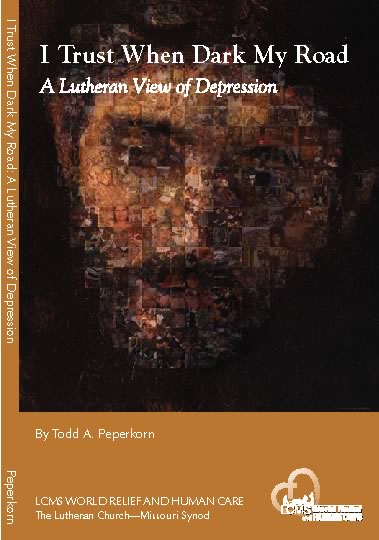
The book I Trust When Dark My Road: A Lutheran View of Depression by the Rev. Todd Peperkorn is again in print from LCMS World Relief and Human Care.

I highly recommend this free (plus shipping) 100 page read to clergy and congregations. The author tell's the story of his descent into mental illness, his diagnosis, and his recovery to a life of joy as pastor, husband, and father.

Order your free copy while supplies last.

The Lord bless your soul.

-oms

Monday, February 1, 2010

I Trust When Dark My Road


O My Soul:

Well, well! On your first read you arrogantly dismissed the Rev. Todd Pepperkorn's book entitled

I Trust When Dark My Road: A Lutheran View of Depression

I thought, "That doesn't sound so bad." But I am clinically depressed and haven't read a complete book in over year, let alone analyze the content of one. Nor do I yet fully grasp what has been happening to me.

So I began digesting this hundred page gem - sentence by sentence and half chapter by half chapter - to completion.

My wife exclaimed after she read Chapter Two: The Place of the Family, "So that is what is happening to us!" Dad's growing anger and both emotional and physical withdrawal from her and our three children.

Through the fog of my depression, a new view of the last twenty-five years began to emerge. Teenage depression in the 1980's triggered by divorcing parents. The severe recurrence of that depression while cutting my teeth as a pastor on the foreign mission field in the 2000's. (But, hey, the 1990's weren't so bad:) Anyway, the Reverend Pepperkorn's description of his descent into mental illness is helping me become aware of my own descent into that "ghastly landscape called clinical depression" as described in the introduction by Dr. Beverly Yahnke.

Chapter One addresses the Build Up to the Fall. Chapter Three reviews The Early Signs That Things Were Wrong. The fear of anti-depressant medication is discussed in Chapter Four: The Pill That Marked Me. The rest of the book describes one husband/dad/pastor's journey to a healing that most depressed people never experience due to nothing but a crushing fear that has the capacity to suck the life-breath out of you. In fact, suicide is the topic in Chapter Nine: Thinking the Unthinkable.

The take home message is that Jesus Christ, the Suffering Servant, does not forsake His people. He is near you. His death is for you. He provides doctors, psychologists, pastors, family and friends to deliver His care and cure to you.

Are you the spouse or friend of a mentally ill soul? Read Appendix 1: What to do if a loved one suffers depression.

Are you a pastor without a pastor? Read the Addendum by the Rev. Dr. Harold Senkbeil to help you find a pastor to speak God's grace into your situation.

I encourage you to read this book.

Thank you to the Reverend Todd Pepperkorn for writing this book.

Thank you to the Reverend Matthew Harrison for bringing this book to publication through LCMS World Relief and Human Care of the Lutheran Church Missouri Synod.


-oms